
Teshuvah in the Torah of Moses from the Plates of Brass
Teshuvah is not merely something we do, as human beings, re-aligning ourselves with God. It is as an act of love and mercy on God’s part.

Kabbalah and the Spiritual Path
One question I am often asked is how one can strengthen their relationship with God, particularly during periods of doubt or when one is feeling disconnected from God. As a Mormon Kabbalist, I generally endorse Kabbalistic principles. Kabbalah is the mystical arm of Judaism. Like Mormonism, it seeks to understand the truth of God and the universe. It incorporates a variety of spiritual practices, including prayers, meditation, and scripture. The idea is that anyone can achieve greater spiritual awareness and connection with the divine. Like Mormonism, Kabbalah places a strong emphasis on personal revelation and direct communication with God.
As Above So Below
In Hermetics, there is an axiom: “That which is above is like to that which is below, and that which is below is like to that which is above.” Or in layman’s terms, “As above, so below; as below, so above.” This statement is found on the Plates of Brass in the headings of Chapters 3 and 4 of 1 Moses, which leads us to ask: What does this mean, and how is it relevant to us today? I have spent considerable time pondering this idea and would like to share my thoughts.

Praying the Rosary?
The need for the Rosary I’ve been looking for ways to improve the effectiveness of the time I spend in thoughtful meditation. I have a tendency to zone out after just a few minutes of peaceful contemplation. Various meditation strategies have been used throughout time to overcome this problem. People have used mantras, sudras, mandalas, drums and all kinds of other repetitive technologies to give the “monkey mind” something to focus on so it doesn’t check out entirely. Within the Catholic tradition, the rosary beads can serve this purpose. With just a little “training”, the person praying the rosary can get lost in the prayers and reverence and allow the tactile sensations of the beads in their hands keep them their mind on track. I decided I wanted to benefit from that same strategy. And I decided to come up with a Kabbalistic meditation that uses a standard Catholic rosary…

Multiple Mortal Probations
Note: This article originally ran February 8, 2020.
“Thus are the five stages of man: Intelligence, Spirit, Flesh, Soul, and Resurrected Being; the final being all stages in one, a Morning Star—forever complete.” –Melchizedek 4:9
The Church of Jesus Christ in Christian Fellowship has no official position on gilgul (גלגול, Hebrew for “rolling”), past lives, reincarnation, or multiple mortal probations (or MMP). There are a number of views on these within the Latter Day Saint movement, from their necessity to reach the highest degrees of Heaven, to outright disdain. Here we will introduce you to some of these concepts as they relate to both the Latter Day Saint movement and Kabbalah. Please note that this is just an introduction. More study on these topics is encouraged.

Who of all these parties are right?
I had a rather interesting flash of inspiration over the weekend.
I’ve been pestering the LORD with the same basic question for several months, and lately that pestering has been more and more frequent. The root question I’ve been drilling on is how these different seers can bring forth these different records that are at odds with one another. And, to compound that problem, the prophets themselves tend to not feel particularly inspired about the records brought forth by other prophets.

Latter Day Sisterhood
The Sisterhood of Christ is doing more than give women a voice in the Lord’s Fellowship; it is extending the keys of the priesthood of God to any woman who feels called of God to do His works.

The Miktabim
On Friday, January 12, 2024, David saw online a symbol that he had seen in the plates of brass, the seal to be engraved (cut, carved, or sewn) upon a holy coat: “…thou shalt engrave the seal upon the inside of it; and in the middle of the seal put the letters, and around the seal thou shall write: YHVH, may this chereb do Thy services, and may the Lord of it approach!” -4 Moses 32:42 This led David to learn more of Rabbi Moshe Cordovero and his ideas on the Sefirot, but in the short time he had to search all he found were commentaries. After praying and sleeping on what he had read and discussed with a friend on the topic, he retired to bed. In his evening and morning prayers, he asked the Lord to help him uncover more light and knowledge on this symbol. The following…

Garments of the Priesthood
“Let all thy garments be plain, and their beauty the beauty of the work of thine own hands; and let all things be done in cleanliness before me.” -Doctrines of the Saints 4a:51
As a part of receiving one’s Initiatories we are given the Garments of the Priesthood. Into these garments symbols are sewn or cut, that they may function much like a classic amulet that has power from God. What are these garments? When should we wear them?
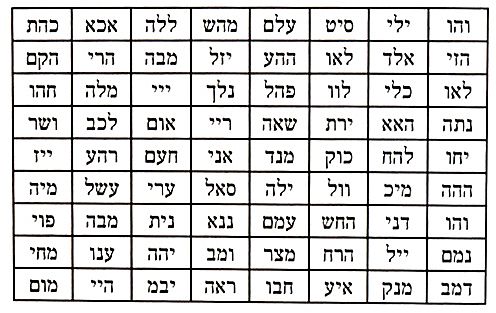
Shem HaMephorash: The 72 Names of God
Shem HaMephorash, or the 72 Names of God, are not literally the names of God. Rather, they are powerful meditations designed to help us focus and use the gifts of the Spirit.

Gematria
“It is better to trust in YHVH than to put confidence in man.” -Psalm 118:8
Gematria is the practice of deriving deeper insights and meanings from the Torah by combining the numerical values of Hebrew. Each Hebrew letter has a corresponding numerical value. The most common method used would be adding up the numerical values of the letters in a word or phrase. Then, practitioners look for other words or phrases that add up to those same numbers. The idea is that this method will uncover hidden connections, and deeper meanings and understandings.
The Tradition of Mormon Kabbalah
While Nephi warned us against stagnation, he also taught the Kabbalistic idea of continuing ever forward in God.