…walk into the temple, yea the house of study and even the house of prayer, therefore complete these that thou mayest return into the world of men in perfection.”
–Book of Remembrance 25:10
Throughout this series, we have seen how God uses sacred spaces to teach us about ourselves. From the Garden in Eden to the city of New Jerusalem, Scripture teaches through one continuous story. It is not merely a story of places or buildings, but the story of humanity. Every sanctuary revealed by God in the Bible- the Garden of Eden, Noah’s Ark, the Tabernacle of Moses, Solomon’s Temple, Ezekiel’s Temple, the heavenly sanctuary seen by John, and finally the New Jerusalem– each reveals another layer of the same eternal pattern. Each is an earthly reflection of a heavenly reality. Each points beyond itself toward the restoration of God’s children.
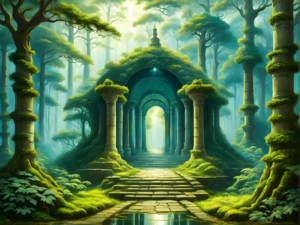 We have looked at how, in Mormon Kabbalah, that eternal pattern is understood through Adam Kadmon, the pre-mortal template of humanity eventually redeemed as the Adam Elyon. Before there was a temple of stone, there was the eternal image of humanity in Christ. Before there was a sanctuary built by human hands, there was the heavenly sanctuary from which all sacred space receives its meaning.
This is why sacred geometry matters. It is not because God prefers certain measurements or architectural styles. It is because geometry becomes a language through which heaven teaches eternal relationships. Every square reminds us of justice, every circle teaches of eternity, every gate is an invitation, and every courtyard a progression. Likewise, every tree reminds us of growth, of life. Every altar teaches sacrifice, and every meal allows for fellowship. Every lamp reminds us of revelation, and every garden teaches stewardship. Every step teaches ascent into the presence of God. We can see that the temple is not merely a place where we can find God, it is a place where humanity remembers who we have always been.
The Command to Build Temples
Doctrines of the Saints Section 124 beautifully gathers these themes into one revelation. In it, the Lord commands us, His people, to build a tabernacle, yet immediately transforms our understanding of why. In this revelation, God declares:
Do not think that I ask this of thee that I might have a place to dwell, for all the earth is the footstool of my creation; and think thee not that thou must enter mine house to know me or to dwell in my presence; for behold, I say unto thee: Where thou art, there am I also.”
–Doctrines of the Saints 124:59-60
The revelation overturns nearly every earthly assumption people make about temples. God is not homeless, God does not require buildings in order to exist. God does not hide is His presence behind sacred walls, neither does mankind hide God in our temples. Instead God teaches:
Where thou art, there am I also.”
–Doctrines of the Saints 124:60
This single declaration changes everything! The purpose of the temple is not to bring people into God’s presence, it is to bring God’s people together. It is for Israel, for building the Kingdom. The Lord explains:
Thou doeth not come into my temples to be in my presence, but thou and thy fellow Saints bring my presence into mine house.”
–Doctrines of the Saints 124:61
This may be one of the most profound temple theologies found anywhere in Restoration scripture. I grew up being taught that temples were sacred places where God’s hidden mysteries were kept. This revelation flipped the script, so to speak, for me. The temple is just a building, the rituals are a drama representing our internal state. I was always told the temple was “sacred, not secret” as an excuse to keep it secret. I now understand it was never meant to be secret at all. It cannot be, as our actions teach the world exactly what we learn in our temples. We cannot hide anything because if we take our temples seriously, we become the sanctuary, the congregation becomes the Shekinah, and the Fellowship itself becomes a resting place of God. This echoes the teachings of Jesus, who declared that when two or three of us gather in His name, He is with us (Matthew 18:20). It fulfills Paul’s teaching that believers are “the temple of God” and that God’s Spirit dwells within them (1 Corinthians 3:16, 6:19-20). It echoes Peter’s vision of disciples becoming “living stones” built into a spiritual house.
The Holy of Holies
And the Holy of Holies shall no more be kept hidden, but shall be used to house my bride, my Shekinah, even the congregation of my Church; for ye are my body, wherefore ye are worthy to enter and partake of the supper of the covenant of our marriage, yea even the Sacrament of Communion.”
–Doctrines of the Saints 124:7-8
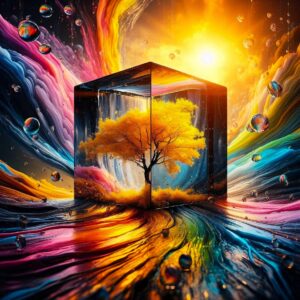 Section 124 expands this idea further, as the Holy of Holies is no longer hidden behind an inaccessible veil. Instead, it becomes the gathering place of the Bride. The revelation declares that the Holy of Holies shall house the Shekinah, “even the congregation of my Church” (Doctrines of the Saints 124:7). This is deeply significant within Mormon Kabbalah as the veil no longer separates humanity from God. The lone High Priest is no longer the only person with access, the curse of Israel has been lifted (3 Moses 32:5-6). The veil becomes the place where heaven and earth embrace, communion the marriage supper, and the congregation becomes the Bride. We need to see the temple as the home of covenant fellowship, and not of religious exclusion.
Every measurement within the revelation reinforces this vision. The cube of the Holy of Holies recalls both Solomon’s Temple and the cubic city of New Jerusalem described in Revelation, mapping out the fundamental building blocks of creation. The eastern entrance recalls Eden, and our return to the Presence of God in the Garden. The menorah recalls the Tree of Life, and the reality that we are made in the image of God. The fire, His divine light. The shewbread reminds worshippers that no one should leave hungry, it is our role as kings and queens, priests and priestesses to feed the people physically and spiritually. The altar of incense teaches continual prayer. The sacred groves surrounding the temple restore the forests where prophets once met God. The mikveh reminds disciples that life is one continual return to covenant through cleansing and renewal. Even the temple grounds teach us! The orchards are not ornamental, they feed strangers. The sacred groves are not private retreats, they become places where children laugh, women sing, families gather, and creation itself joins in worship. This is sacred geometry made visible through life and thought compassion.
The revelation also transforms our understanding of priesthood. Yes, we are all called to be kings and queens, priests and priestesses, patriarchs and matriarchs, and servants and teachers. None exist to establish hierarchy. Rather, we all exist to strengthen fellowship. There is no first among equals, there are only equals. There is no “benevolent dictator.” We are not a people called to follow a prophet, we are all called to be God’s prophetic people. Every office serves the same temple, every calling builds the same Zion. Every gift contributes another living stone to the eternal house of God.
The House with in the House
 Most remarkable of all is the revelation’s final invitation. After describing sacred architecture in extraordinary detail, the Lord quietly says:
But behold, it is my will that all shall have a temple in their homes, that these might too be my synagogues and ye may seek my face wherever ye may be each day.”
–Doctrines of the Saints 124:54
The cosmic temple is no longer confined to Jerusalem, nor to Zion, nor even to an organized church or congregation. Every home may become a sanctuary, and every dinner table may become an altar of thanksgiving. Every garden may become Eden, and every act of forgiveness an ordinance. Every hymn may become temple worship, and every shared meal a communion. Every visitor welcomed through our doors may become Christ Himself. In this way, sacred geometry leaves the drafting table and enters ordinary life. When we forgive, heaven and earth align. When we feed the hungry, the Tree of Life bears fruit again. When we welcome strangers, the gates of Zion open.
Our religion is personal, and it is relational. God heals us, and we pay it forward. When we heal the brokenhearted, the rivers of Eden begin flowing once more. When we gather around the table, Christ presides. When we love one another, entering true oneness, the temple is complete.
The True Temple
But I saw no temple in it, for the Lord God Almighty and the Lamb are its temple.”
–Revelation 21:22
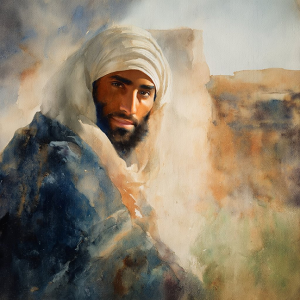 Ultimately, every pattern explored throughout this work points toward one Being: Jesus Christ. Yes, Jesus Christ is the true Temple, He is Jacob’s Ladder joining heaven and earth. He is the Cornerstone upon which every sanctuary rests, and He is the Great High Priest who enters the Holy of Holies. He is the Bread upon the table, and He is the Light upon the menorah. He is the Living Water flowing from the sanctuary, and He is the Tree of Life standing again in the midst of Paradise. He is the Bridegroom welcoming His Bride, and He is the New Jerusalem’s everlasting light. Adam Kadmon finds its fulfillment in Him as Adam Elyon. The Tree of Life blossoms through Him, the Garden is restored because of Him, the Tabernacle exists to teach of Him. Solomon’s Temple points toward Him, Ezekiel’s vision anticipates Him, and The New Jerusalem shines because of Him. The Restoration bears witness of Him.
Sacred Geometry and Mormon Kabbalah, for that matter, at its heart, is therefore not about sacred symbols, mystical language, or hidden patterns. It is about learning to see Christ everywhere. It is about discovering that every true temple, whether built from cedar, stone, canvas, orchards, families, or faithful hearts, exists for one purpose: to help humanity become more like Jesus Christ. This is the great restoration. He showed us in His life, outlined in the New Testament Gospels, who we were before we were born and who we will be once resurrected in Him. Joseph Smith was not called merely to restore ordinances, or even ancient teachings. He and every prophet and prophetess, Patriarch and Matriarch, Apostle and Elder that came after him were called to restore far more thn priesthood keys or scripture. The call is about is the restoration of humanity itself.
From Adam Kadmon to Adam Elyon
Wherefore it must be that the whole Adam, the finished Adam, the Adam Elyon must be all of these; and this is not a creation that mankind can make of themselves; therefore, it must be the very work of YHVH, our Elohim.”
–Zenock 11:15-16
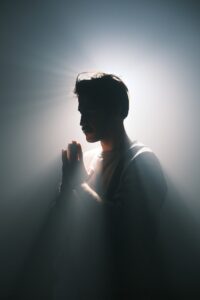 As the image of God is renewed within us, the eternal pattern of Adam Kadmon shines ever more clearly. The cosmic temple is rebuilt, not one stone at a time, but one transformed life at a time. Zion emerges wherever people choose covenant over competition, generosity over greed, mercy over judgment, and fellowship over division. The final temple, then, is not simply a city descending from heaven. It is a people, is it (or can be) us! It is a people whose lives have become sacred space, a people who carry the Presence wherever they go. It is a people who, through the grace of Jesus Christ, have become living temples filled with the Light of God. It is my prayer that we may become those living stones.
May our homes become sanctuaries. May our communities become gardens. May our fellowship become Zion. And may the pattern revealed from Eden to the New Jerusalem find its fulfillment in us, until God is truly “all in all,” and heaven and earth are forever united in the everlasting Kingdom of Christ. So please, do not let your temple walk be “sacred, not secret;” rather, let the light of Christ shine from you to help heal this creation. Let God’s love be your love, let your hands be His hands, and our works, together in His name, truly be His.