Behold: the inner court of my temples, or the Holy of Holies, shall be set to the westernmost end, and it shall be 20 cubits, by 20 cubits, by 20 cubits, which is to say 30 feet, by 30 feet, by 30 feet; but for thy purposes at the present, it shall be 15 feet, by 15 feet, by 15 feet; and this too ye shall do for my synagogues, but my temples shall be 30 feet, by 30 feet, by 30 feet in my Holy of Holies.”
–Doctrines of the Saints 124:5-6
Before we start into these articles, I want to be clear that I am not an expert in sacred geometry. I find it interesting, but I have not studied it enough to pretend to do little more than share these, my thoughts on the subject. These articles are an invitation to go to better sources and study these topics on your own. They are also an invitation to any who are better versed on this topic to write articles, and perhaps even create a course in the School of the Prophets on this topic.
So what is sacred geometry? When many people hear the phrase, they imagine mysterious symbols, hidden mathematics, or secret knowledge reserved for a select few. In Mormon Kabbalah, however, sacred geometry is something much simpler and much more beautiful. It is the recognition that God created the universe with purpose, order, harmony, and relationship. Throughout Scripture, the Lord repeatedly reveals sacred patterns. It is visible from the measurements of Noah’s Ark to the Tabernacle of Moses, to Solomon’s Temple, to Ezekiel’s visionary temple, all the way to the New Jerusalem. These designs are not arbitrary blueprints but visual sermons, teaching eternal truths about God’s character, humanity’s divine calling, and the relationship between heaven and earth. Sacred geometry is, in a way, the language of creation. It reveals the wisdom governing the stars, the seasons, and the growth of a tree. It even shapes the covenant life of God’s people. In this first segment, we will look at ways God uses symbols and geometry to teach us about ourselves.
Joining the Heavens and the Earth
And the spirit and the flesh and the soul, these three become one man or one woman; and this one is thus belonging to the kingdom of YHVH Elohim. And as one, Adam (humanity) made whole, shines forth the divine light of life.”
–1 Moses 46:15-16
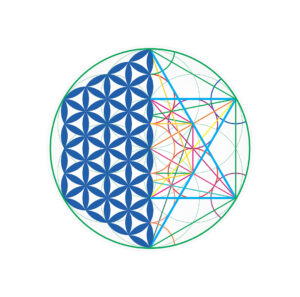 Throughout history, people have been drawn to sacred places. Across cultures and civilizations, mountains, temples, circles of stone, gardens, tabernacles, and sanctuaries have been built with remarkable care and intention. While these structures vary greatly in appearance, they often share a common purpose: to create a place where heaven and earth meet. For many people today, sadly, temples have become mysterious or inaccessible. Some are viewed primarily as monuments to religious identity. Others are seen as places reserved for a select few. Still others have become museums of ancient ritual, admired for their beauty but disconnected from everyday spiritual life. As a result, many sincere seekers ask an important question: What is a temple actually for?
Within Mormon Kabbalah, the answer begins long before a single stone is laid. A temple is not first a building, it is not an institution. It is not even a ritual or an ordinance. A temple is the physical expression of an eternal reality that has always existed in the heavens. And to understand sacred architecture, we must first understand ourselves.
Humanity Before the Foundations of the World
Thus are the five stages of man: Intelligence, Spirit, Flesh, Soul, and Resurrected Being; the final being all stages in one, a Morning Star—forever complete.”
–Melchizedek 4:9
One of the distinctive teachings of Mormon Kabbalah is that every human being existed with God before we were born. This belief is familiar to many readers of the Book of Mormon and Restoration scripture. We believe that our spirits are older than the earth itself, and our intelligence is eternal. Mortality is not our beginning but one very small chapter within a much larger eternal journey.

Mormon Kabbalah builds upon this Restoration teaching by describing our pre-mortal existence through the ancient Kabbalistic image of Adam Kadmon. In many traditional streams of Jewish Kabbalah, Adam Kadmon represents the primordial or archetypal human through whom the Divine Light first flows into creation. Mormon Kabbalah adopts this symbolism while understanding it in a distinctly Restoration context. To us, Adam Kadmon is not merely an abstract cosmic figure. In stead, Adam Kadmon represents the eternal pattern according to which every soul was created.
Before we were born, each of us existed as our complete eternal self (intelligence) within the presence of God. We were organized according to that divine intelligence and given spirit bodies. Our spirits possessed purpose, identity, gifts, relationships, and eternal potential. Our earthly bodies are not accidents of biology but temporary tabernacles designed to reflect that eternal pattern.
In this sense, Adam Kadmon is not someone separate from us. Adam Kadmon is the heavenly architecture from which every son and daughter of God was fashioned. Our physical body then become a reflection of an already-existing spiritual reality. Our lives, therefore, are not about becoming something entirely new, but remembering who we have always been. Resurrection isn’t what we grow into, but a return in Christ to what we were before we were even born, uniting our true selves forever as one unified being.
Temples Exist Because We Exist
Behold, each part of my tabernacle and my temples were given to represent the things of this earth and the bringing of the heavens to the earth.
–Doctrines of the Saints 134:17

This understanding transforms the way we think about temples. Many assume temples exist because God desired sacred buildings, but what need has an all-powerful God for buildings made of human hands? Mormon Kabbalah reverses that order. Temples exist because humanity itself is sacred! The first temple was not built with cedar beams or carved stone, the first temple was the eternal soul. Only afterward did humanity begin constructing buildings that reflected what already existed within us.
This idea appears repeatedly throughout scripture. The Tabernacle of Moses was constructed after Moses was shown a heavenly pattern. Solomon’s Temple reflected heavenly realities. Ezekiel saw an ideal temple before it existed upon the earth. John saw the heavenly temple before describing the New Jerusalem. In every case, the heavens came first, then earth follows. By this we see that the earthly temples are not the original, they are the copy. This principle becomes one of the central teachings of Mormon Kabbalah: The heavens are the blueprint (Adam Kadmon), earth is the construction site.
Sacred Geometry as Divine Language
Who hath measured the waters in the hollow of his hand, and meted out heaven with the span, and comprehended the dust of the earth in a measure, and weighed the mountains in scales, and the hills in a balance?”
–Isaiah 40:12
 This leads naturally to the study of sacred geometry. To many modern readers, sacred geometry sounds mysterious or even occult. In reality, the idea is much simpler. Geometry is nothing more than ordered relationship. Every snowflake follows mathematical order. Every flower unfolds according to measurable proportions. The human body develops through astonishing patterns of symmetry. Galaxies spiral according to predictable laws. Music itself depends upon mathematical harmony. When we see that harmany we begin to understand that the creation was not random, creation is ordered, structured, planned.
Scripture repeatedly teaches that God is a God of order rather than confusion. Sacred geometry then would be the study of divine order as expressed throughout creation. To be clear, geometry is not something to be worshiped, numbers are not magical. Think of geometry more as a language God uses to teaches eternal principles. We see this pattern already in our understanding of basic shapes.
- Circles remind us of eternity
- Squares symbolize stability
- Triangles remind us that heaven, earth, and humanity exist in relationship
- Gardens represent life
- Mountains symbolize ascent toward God
- Light flowing downward reminds us that revelation comes from heaven before it transforms the earth
None of these symbols possess power by themselves, but they do point beyond themselves toward eternal truths. Just as words communicate ideas, geometry communicates divine relationships.
The Living Tree

And I also beheld that the tree of life was a representation of the love of God.”
–1 Nephi 3:36 [11:25b]
Among the most important expressions of sacred geometry is the Tree of Life. Many readers first encounter the Tree of Life through Lehi’s vision in the Book of Mormon, others know it from Genesis, and others recognize the Tree of Life from Jewish Kabbalah. The symbol for Mormon Kabbalah is the white tree from Lehi’s dream with the Jewish Tree of Life symbol within a circle representing eternity. This is because, in Mormon Kabbalah, we see these as complementary witnesses that describe the same eternal reality from different perspectives.
To us, the Tree is not merely a diagram, it is a living pattern. Its branches remind us that all creation proceeds outward from divine love. Its roots remind us that all things remain connected to their Source (Malchut, Kingdom). Its fruit reminds us that the purpose of creation is life. Its light (Ha’Or En Sof, the light of Christ) reminds us that Christ is the center of every true temple. The Tree of Life also illustrates how revelation flows. God’s love ascends and descends, humanity responds, and the creation is transformed. The Tree is therefore both cosmic and deeply personal. It describes the universe, and it describes your own soul.
Adam Kadmon as the Living Temple
And the first stage of man, the eternal man Adam Kadmon that was never born and shall never die, was brooding upon the face of the waters.”
–Melchizedek 4:5
We know what the Tree of Life looks like, but how do we use this Tree of Life in our own lives? How can it be useful to the average person? There are two ways: we can see it as a map of God and as a map pf ourselves. We are, after all, made in the image of God (1 Moses 3:39, Genesis 1:26). If the Tree of Life represents divine order, then Adam Kadmon represents divine embodiment. Imagine the Tree not as separate circles floating in space but as living relationships expressed through an eternal person:

- Keter as Love.
- Da’at as Knowledge
- Chokhmah as Wisdom
- Chesed and Mercy
- Gevurah as Justice
- Tiff’eret as Beauty
- Netsah as Endurance.
- Hod as Majesty
- Yesod and the Foundation
- Malchut as the Kingdom
These are not merely isolated virtues, they are dimensions of a complete soul. The Adam Kadmon represents humanity in its pre-mortal perfected harmony, Adam Elyon as our resurrection in Christ to eternal perfection and glory as the right hand of God. When Mormon Kabbalah teaches that we are created according to Adam Kadmon, it is saying something profoundly hopeful: We were created for eternal wholeness. Here in the mortal world, sin fractures, fear divides, pride isolates, and violence distorts. Yet beneath every wound remains that original pattern, the Adam Kadmon. If we chose Jesus, we are made whole again in His atonement. But we see that the work of Christ is not creating worth where none existed, it is restoring what was always intended. Salvation then becomes restoration, healing becomes remembrance, and repentance (teshuvah) becomes returning to our eternal design.
Jesus Christ: The Perfect Temple
Jesus answered and said unto them, Destroy this temple, and in three days I will raise it up.”
–John 2:19
At the center of Mormon Kabbalah stands Jesus Christ. Without Him, sacred geometry becomes little more than philosophy. Without Him, temples become  museums. And without Him, Adam Kadmon remains an unrealized possibility. Jesus reveals what a perfected humanity looks like. He is the perfect image of divine love embodied. Every action of Christ reflects perfect harmony between heaven and earth. His compassion reveals heavenly compassion, His mercy reveals heavenly mercy, His forgiveness reveals heavenly forgiveness. His life becomes the living temple toward which every earthly temple points.
When Christ declared that the temple would be destroyed and raised again in three days, He pointed toward Himself (John 2:19-21). His resurrected body became the meeting place between God and humanity. Through Him, every believer is invited into that same relationship. In this way, Mormon Kabbalah understands temples not as replacements for Christ but as witnesses of Him. Every altar points toward His sacrifice, every source of light points toward His glory, every veil points toward His mediation, every garden points toward resurrection, and every living stone points toward transformed disciples.
Temples Heal Communities
And beyond the walls of my temples ye shall grow unto me sacred groves of oak trees, and of nut trees, and of trees bearing all manner of fruits; and this ye shall do that my people and all of my creation may find nourishment and be filled of the good things of my creation.”
–Doctrines of the Saints 124:41-42
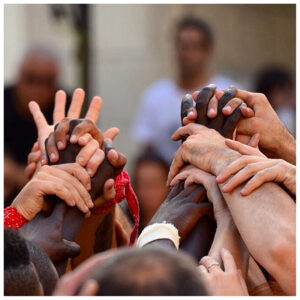 If temples reflect heavenly realities, then their purpose extends far beyond ceremonial worship. A true temple should bless everyone around it. As a School of the Prophets, it should become a center of learning. A place where children are welcomed, a school where wisdom is freely shared. As a house of worship, it is a place of reconciliation. As a place of gathering, a refuge for the lonely. A place where strangers become neighbors. A temple is a sanctuary for prayer, its grounds a garden that feeds the hungry.
In Mormon Kabbalah, sacred geometry therefore extends beyond architecture, a temple’s true shape is seen in the lives it transforms. Perfect measurements mean little if compassion is absent. Beautiful buildings are empty if justice is neglected, the geometry God desires is ultimately relational. Remember, communities are shaped by kindness, families are shaped by forgiveness, friendships are shaped by covenants of love, and Churches are shaped by hospitality. When these patterns emerge, the temple has already begun to appear, even if no physical building yet exists.
Building from the Inside Out
And now, behold, I ask of you, my brethren of the Church: Have ye spiritually been born of God? Have ye received his image in your countenances? Have ye experienced this mighty change in your hearts? Do ye exercise faith in the redemption of him who created you?”
–Alma 3:27-30 [5:14-15a]
This perspective changes how we approach both spirituality and temple building. Instead of asking, “How do we build a temple?” Mormon Kabbalah asks, “How do we become the kind of people who naturally build temples?” Sacred architecture begins in the heart, it takes a temple to build a temple. Every act of forgiveness restores one stone, every act of generosity plants another tree. Every effort toward reconciliation aligns another line within the eternal geometry of heaven. Communities become temples because individuals first become temples.
As this happens, the heavenly Adam Kadmon gradually shines through our earthly lives. We begin remembering the eternal pattern written upon our souls before the foundation of the world. That remembrance is not merely intellectual, it transforms how we live, how we love, and how we build. If it does not transform us, how can we call it a holy place? Ultimately, the purpose of the temples are to teach us how to see every person around us: not as strangers, but as eternal beings created according to the same divine pattern.