They are to make me a sanctuary, so that I may live among them. You are to make it according to everything I show you — the design of the tabernacle and the design of its furnishings. This is how you are to make it.”
–Exodus 25:8-9
As we dive deeper into sacred geometry, it is easy to get lost in complicated diagrams or mysterious symbols, seeking hidden mathematical codes or esoteric knowledge that may or may not even really be there. Let’s take this topic to its most basic level: the practice of paying attention to the ways shape, proportion, number, space, and physical design can communicate spiritual ideas. This is particularly important when we talk about temples.
Sacred Spaces in Scripture
I come up into the temple this day that I might declare unto you the word of God.”
–Jacob 2:2 [2:2]
Throughout Scripture, God gives His people detailed instructions concerning sacred spaces. As noted in the previous sections, the Tabernacle of Moses was measured very carefully. Solomon’s Temple had specified dimensions and proportions. Ezekiel’s visionary temple was described in extraordinary architectural detail. The New Jerusalem is likewise presented through measurements and geometric imagery. In much the same way, the revelation given to the Fellowship of Christ to build tabernacles, synagogues, and temples also holds specific numbers and shapes. These measurements are more than construction instructions, as physical space can become a teacher.
Mormon Kabbalah approaches these patterns with the conviction that creation itself is ordered and meaningful. The physical world can point toward spiritual realities. A temple can become a miniature representation of the relationship between heaven and earth, and its architecture can teach us something about our own journey toward God. Again, this does not mean that every number in Scripture has one secret meaning. Nor does it mean that every measurement should be turned into a mathematical formula. Sacred geometry is best approached as a language of possibility, symbolism, relationship, and contemplation.
It should also be noted that this is especially important for those who are new to Mormon Kabbalah. The ideas explored here are not presented as universally accepted interpretations within Judaism, Christianity, Latter Day Saint traditions, or Kabbalah. Jewish mystical traditions themselves contain many different approaches to numbers and symbols, and gematria has historically been used in different ways. Rather, Mormon Kabbalah draws upon these traditions as a way of contemplating revelation and seeking patterns that may illuminate the Restoration. With that foundation in mind, let us look at shapes and numbers associated with the proposed temple design of the Fellowship of Christ.
The Holy of Holies as a Cube
This sanctuary was thirty-five feet long, wide and high; and it was overlaid with pure gold. In front of it he set an altar, which he covered with cedar.”
–1 Kings 6:20
A central feature of the temple design is the Holy of Holies. In the revelation given to the Fellowship in 2021, the Lord instructed that the Holy of Holies in the temple should be 20 × 20 × 20 cubits. Today we do not use this form of measurement, we use centimeters and inches. Here in the US, we use the imperial system, feet, rooted in ancient body measurements from Egypt, Greece, and Rome. While the cubit was the average forearm, the foot was originally based on the average length of a human foot. Because both are common measurements, the fact that they are tied to the human body can be made to be symbolic, but is also very practical. God isn’t inventing a new way of measuring, but using what already exists.
 The Lord takes this number of cubits, and gives us new numbers in feet, providing a smaller 15 × 15 × 15 design for the tabernacles and synagogues. Exodus 26:33 states:
Hang the canopy from the fasteners in the ceiling, and put the ark containing the words of my promise under it. The canopy will mark off the most holy place from the holy place.”
If the entire tent of the tabernacle was 30 cubits long by 10 cubits wide by 10 cubits high, and the inner veil was placed 20 cubits from the entrance, dividing the structure into a 20 x 10 x 10 cubit Holy Place, then the Holy of Holies would have been a perfect 10 x 10 x 10 cubits. For the Fellowship, the larger temples would ultimately have a Holy of Holies at twice that size, measuring 30 × 30 × 30 feet, just as the ancient temple of Solomon’s Holy of Holies was twice the size.
Whatever additional symbolism we may find in these numbers (we will cover that in the following installment), two features immediately stand out: The Holy of Holies is a cube, its length, width, and height being equal, and from the tabernacle to the permanent structure of a temple, the size is doubled. This is significant because the cube has a long biblical association with sacred space. The ancient text Sefer Yetzirah (The Book of Creation) maps the foundational building blocks of the universe using the Hebrew alphabet and a conceptual “Cube of Space.” The six faces of the cube correspond to the six emotional attributes (midot) of the lower divine structure (Zeir Anpin), anchored by a center point of holiness in Jewish Kabbalah. We can see that the Fellowship’s proposed dimensions are not merely an attempt to create an interesting modern architectural form. The Lord is deliberately connecting the temple design with an ancient biblical pattern.
Book of Mormon Temples
The Book of Mormon gives us another important connection. Nephi tells us:
And I, Nephi, did build a temple; and I did construct it after the manner of the temple of Solomon, save it were not built of so many precious things.”
–2 Nephi 4:22 [5:16a]
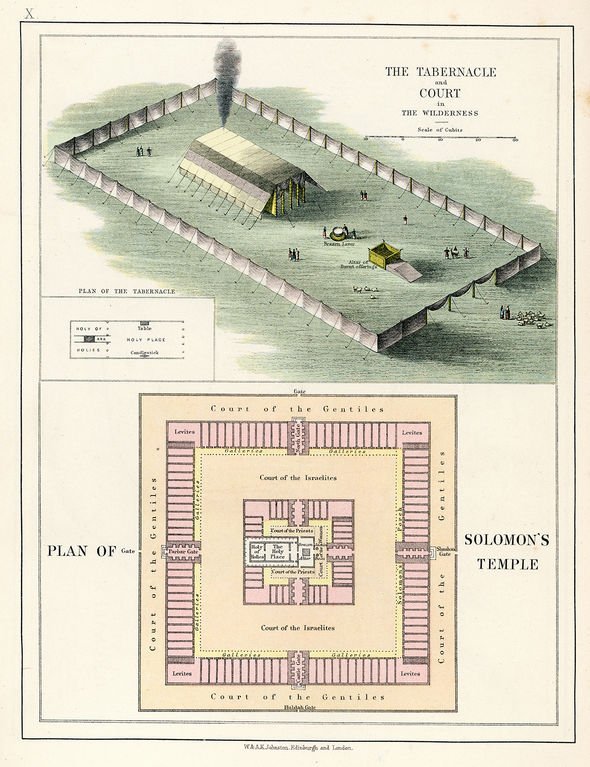 This is an important passage for understanding temples in a Restorational context. Nephi did not simply build a religious meetinghouse, he deliberately connected his temple with the pattern of Solomon’s Temple. But he did so without all the gold and prestige. This is a bold statement: it is the architecture, not the wealth, that is important. As long as the design is there, it is a temple, not the “precious things.” It would be wise to add that it is even more the spirit we bring to the temple that makes it a House of the Lord.
This tells us something important about Restoration scripture: temple architecture can carry memory. A temple can connect one generation with another. Nephi’s temple connected the people of the New World with the ancient temple tradition of Israel. In turn, the Restoration can look back to both biblical and Book of Mormon temples while seeking new revelation about what temples can become. We can build a modern house of the Lord in a way that makes sense to us, and connects us to Israel’s past in both the Bible and the Book of Mormon.
Why a Cube?
But what they are serving is only a copy and shadow of the heavenly original; for when Moses was about to erect the Tent, God warned him: ‘See to it that you make everything according to the pattern you were shown on the mountain.'”
–Hebrews 8:5
A cube is remarkably stable. It extends equally in every direction. There is no preferred horizontal dimension. Length does not dominate width, and width does not dominate height. Symbolically, this can suggest wholeness, balance, completeness, and equilibrium. The Holy of Holies represents the place of the most intimate encounter with the Divine Presence. In the Biblical and the Book of Mormon Temples, it was the innermost sacred space. The fact that it was a perfect cube can therefore be contemplated as an architectural expression of divine order.
 There is also a fascinating connection at the end of the biblical story. As mentioned in previous installments, the New Jerusalem in Revelation is described as having equal length, width, and height (Revelation 21:16). The city is therefore presented as a cube. This creates a remarkable biblical arc linking the Holy of Holies to the Temple and the temple to the New Jerusalem. The innermost sacred space of the Temple and the final dwelling place of God’s people share the same geometric form.
Perhaps this is where sacred geometry becomes most meaningful. The purpose is not to discover secret codes or prove that every measurement has one predetermined interpretation. It is to learn how to see. A physical pattern can become a spiritual reminder. A cube can suggest wholeness, balance, and completeness. A temple can remind us of heaven and earth meeting. And sacred space can invite us to consider whether our own lives are becoming more ordered, more balanced, and more open to the presence of God.
A Holy People
And if mankind doth accept this teshuvah, I shall wash them clean in the waters of my mercy one degree at a time, but they shall be clean from the first degree.”
–1 Moses 10:9
For the Mormon Kabbalist, this invites an important question: What if sacred space is ultimately teaching us how to become sacred people? The goal is not merely to enter a cube, the goal is to become whole. The cube shape of the Holy of Holies gives us more than an interesting architectural pattern. It provides a way of thinking about sacred space and, ultimately, about ourselves. If the innermost sanctuary is associated with the presence of God whose length, width, and height are equal, the pattern connects the Holy of Holies, the Temple, and the New Jerusalem to a balance of self within each of us to find wholeness. We are not merely human beings divided into work, play, and families. What we do in each segment of our lives bleeds into the others to make us whole. When we find balance in Christ Jesus, we truly connect with the Presence of God. We become the cube, the balanced, perfectly equal, Holy of Holies.
 Just as Nephi built his temple “after the manner of the temple of Solomon” (2 Nephi 4:22 [5:16a]), we are not called to the perfection of Christ, but to be perfected in Him. We can preserve the sacred pattern while struggling with being human, growing grace by grace (2 Peter 3:18). Just as sacred architecture is not ultimately about precious materials or impressive monuments, we should not degrade ourselves for not being perfect on day one. It is about creating a space that points us toward God. More importantly, the temple points beyond itself. Its patterns can teach us how to become the kind of people in whom God’s presence can dwell.
For the Mormon Kabbalist, the temple is more than a building and sacred geometry is more than architecture. Both can become languages through which we contemplate the relationship between the heavens and earth. As we continue exploring the measurements of the Holy of Holies in the next segment, we will look more closely at the numbers 15, 20, and 30 and the symbolic possibilities they offer. We do so not as though we have uncovered the final answer, but as fellow seekers learning to pay attention to the patterns God may have placed before us.