And the church did meet together oft to fast, and to pray, and to speak one with another concerning the welfare of their souls.”
–Moroni 6:6a [6:5]
For those new to Mormon Kabbalah, one of the first questions might be: Is the greater focus on personal spiritual growth, or on building a spiritual community? Many people assume that mystical traditions focus almost entirely on the individual. They think of individual growth through meditation, personal revelation, and inner transformation. While personal growth is absolutely essential, Mormon Kabbalah teaches something deeper: the individual and the community are meant to grow together. One is incomplete without the other.
This idea is rooted strongly in the teachings of the Book of Mormon. From the earliest chapters to the final invitation given by Moroni (10:3-5 [10:3-5]), spiritual growth is shown as something both personal and communal. People receive personal revelation, but they also gather, pray together, and support one another as they grow. In Mormon Kabbalah, this pattern becomes even more meaningful because spiritual unity is seen as part of God’s greater plan—not just for individuals, but for humanity as a whole.
The Individual Soul
To understand the importance of community, we first must understand how important the individual is. In Mormon Kabbalah, we place a strong emphasis on the spiritual journey of each person. Every soul has a unique purpose, a unique relationship with God, and a unique path of growth. No two spiritual journeys are exactly the same. This means that personal prayer, personal revelation, and personal spiritual discipline are not optional, they are essential.
The Book of Mormon reinforces this idea again and again. Its message is deeply personal. Readers are not told to believe simply because others believe. Instead, they are invited to ask God for themselves. The closing promise of the book in Moroni 10 makes this clear: every person can receive a direct witness through the Holy Ghost (10:3-5 [10:3-5]). In Mormon Kabbalah, this teaching becomes central. The individual is not meant to depend entirely on leaders or traditions. Instead, each person is invited to develop a living relationship with God.
Because of this, some people assume that community must be less important. If personal revelation is so central, then why focus on building a spiritual group at all? The answer is that individual growth reaches its fullest strength when it is shared.
Community Is Spiritually Necessary
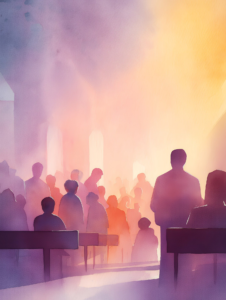 Mormon Kabbalah teaches that spiritual growth is not only inward, it is also relational. People do not grow simply by praying alone. They grow by loving others, learning from others, and supporting others. This is why the early believers described in the Book of Mormon met together often (Moroni 6:6a [6:5]). They fasted together, prayed together, and spoke openly about the welfare of their souls. That phrase is especially powerful. It shows that their gatherings were not only about worship; they were about helping each other grow spiritually.
When people gather with a shared spiritual purpose, something changes. Faith becomes stronger because it is no longer carried alone. Questions feel less overwhelming because they can be explored together. Spiritual experiences become more meaningful because they are shared. In Mormon Kabbalah, this kind of community is seen as a reflection of divine unity. Just as God’s work is not divided or isolated, believers are invited to reflect that unity in their own lives.
Community can also protect spiritual growth. When people try to grow entirely alone, they often become discouraged. Doubt can grow stronger when there is no one to talk to. Inspiration can fade when there is no one to share with. When believers support one another, the spiritual light becomes more stable and more enduring. In this way, community is not a replacement for personal growth, it is the environment where personal growth can flourish.
Balancing Between the Two
 Which is more important then, the individual or the community? Mormon Kabbalah does not treat this as a competition. Instead, it teaches that the two depend on one another, growing out of one another. A healthy spiritual community cannot exist without individuals who are genuinely seeking God. At the same time, individuals grow much more deeply when they are part of a loving and unified group.
Think of it like a living body. Each person is like a cell, unique and essential. But a single cell cannot function the same way outside the body. When the cells work together, life becomes stronger, more complex, and more beautiful. In the same way, spiritual growth becomes deeper when it is shared.
This balance is one of the most powerful aspects of Mormon Kabbalah for new learners. It does not demand that people abandon their individuality. It does not require everyone to think exactly the same way. Instead, it encourages diversity within unity. People can grow spiritually in different ways, yet still support one another. Differences become strengths rather than obstacles.
Why This Matters Today
Many people today feel spiritually isolated. They may believe in God but feel disconnected from traditional religious structures. Others may want deeper spiritual experiences but are unsure where to find them. Mormon Kabbalah offers a meaningful answer to both of these challenges. It teaches that spiritual growth does not have to happen in isolation. At the same time, it proves that it does not have to follow a rigid structure either. Instead, Mormon Kabbalah invites people to build communities centered on prayer, spiritual learning, and mutual support.
This kind of community does not have to be large. It can begin with just a few people who are willing to meet regularly, pray together, and talk openly about their spiritual journeys. Over time, that small group can grow into something much stronger. The focus is not on numbers or organization, but on spiritual sincerity. When people gather with humility and love, the community becomes a place where faith grows naturally.
For new learners, this idea can be especially encouraging. It means you do not have to wait until you feel spiritually “perfect” before joining a group. Growth happens together. Questions are welcome. Doubts are not seen as failures but as opportunities to learn. In this way, the community becomes a safe place for spiritual transformation.
A Path for New Learners
 In Mormon Kabbalah, unity is not just a social idea, it is a spiritual principle. The goal is not simply to gather people in the same place, but to create harmony between hearts and minds. When individuals pray for one another, support one another, and seek God together, they begin to experience a deeper kind of unity. That unity reflects the divine nature itself. This is why both the individual and the community matter so much. The individual seeks God personally, but the community reflects God collectively. One reveals the personal relationship between the soul and God; the other reveals the shared spiritual destiny of humanity.
If you are just beginning to explore Mormon Kabbalah, the most important thing to remember is this: you are not expected to grow alone. Personal prayer and spiritual study are essential, but they are only part of the journey. Look for ways to connect with others who are also seeking spiritual growth. Even small gatherings can become powerful sources of inspiration. Over time, you may discover that community does not limit spiritual growth, but multiplies it. You will see that your faith becomes stronger when it is shared. Your understanding deepens when you listen to others. Your spiritual experiences become more meaningful when they are part of something larger than yourself.
In the end, Mormon Kabbalah does not choose between the individual and the community. It teaches that both are sacred. The individual soul is precious, and the spiritual community is precious. When the two grow together, they create something far more powerful than either could create alone.