
At this point, I am aware of at least four writings explicitly attributed to Moroni, the son of Mormon. In each, Moroni functions as a compiler, abridger, prophet, and speaker across these texts.
- The Book of Moroni (Book of Mormon)
- The Words of Moroni (Sealed Book of Mormon)
- The Record / Book of Mor-Honayah / Mohrhohnahyah (Moroni) (The Sacred Records of the Ancient Nemenhah, title and spelling changed by the translator in edits)
- The Writings of Moroni (Revelation from Moroni given through Havah Pratt)
The first two books appear to have been written after the death of his father, Mormon. The third, after the gold plates were buried. The last is the resurrected Moroni speaking to a prophetess of the restoration. Two in life and one after translation. These texts transition from establishing foundational church governance and doctrine to revealing esoteric cosmological laws, culminating in an urgent, contemporary message regarding spiritual gathering and final protection. Here, we will examine these three writings attributed to this ancient prophet and Latter Day Saint angelic figure.
The Writings of Moroni in Life
The Gold Plates of Joseph Smith
Through Joseph Smith we the first translation from the gold plates, the Book of Moroni. The second, also from the gold plates, we received the Words of Moroni translated by Maurício Berger. We will look at these first as they both claim the same origin, the gold plates during Moroni’s life as a prophet. We read at the opening of the Book of Moroni:
Now I, Moroni, after having made an end of abridging the account of the people of Jared, I had supposed not to have written more, but I have not as yet perished…” –Book of Moroni 1:1a [1:1a]
 However, because he had “not as yet perished” and was wandering for the safety of his life, he was compelled to write “a few more things,” hoping they might be “of worth unto my brethren, the Lamanites, in some future day” (Book of Moroni 1:4b [1:4b]). Looking at these “few more things,” we see an appendix of sorts for the Book of Mormon. Moroni gives us the method of ordaining priests and teachers, the prayers and procedures for administering the sacrament (bread and wine), and the process of receiving individuals into the church through baptism in chapters 2-6. Chapter 7 contains “a few of the words of” his father, “Mormon, which he spake concerning faith, hope, and charity.” Chapters 8-9 are epistles written by Mormon to Moroni, covering doctrinal teachings on issues like “the pure love of Christ.” The Book of Moroni ends with a sermon on faith and miracles in Chapter 10, where he makes an end of his writings and seals up the records so that he might “go to rest in the paradise of God” (Book of Moroni 10:31 [10:34]).
The Gold Plates of Maurício Berger
And now behold, I desire to speak unto those who shall have the words of this book in their hands, after the Lord has stretched forth his arm upon the Gentiles in the latter days.” –Words of Moroni 1:1a
According to Maurício Berger, the Book of Moroni would not be the end! Moroni would write a few more words by way of an abridgment from his own writings in the last chapter of Mormon, Ether, and the Book of Moroni back into the abridgment of more writings compiled by his father, Mormon. The Words of Mormon 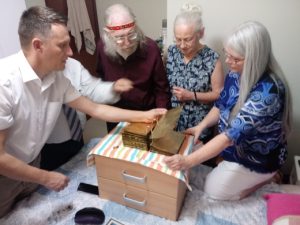 from the Sealed Book of Mormon provides a new understanding of the scope and structure of the entire record compilation. Moroni explains that the total record contained in Mormon’s plates was separated into three sets to be revealed in “three periods of times” (Words of Moroni 1:11). The first set is a “preparatory appendix of the second,” intended to create an alliance between God and the Gentiles through repentance (Words of Moroni 1:12a).
In the Writings of Moroni, we are told that he was commanded to seal his “father’s records and with it the record that the Lord asked” him “to write about what the brother of Jared saw” (Words of Moroni 1:10b). These sealed portions, reserved for a later time, contain what Moroni dubbed “greater things” and include books like the Sealed Book of Moses (Words of Moroni 1:12c). Moroni warns that those who receive the first part of the records but “will not be willing to meditate upon it” and say, “we have enough, and we are not ready for more scriptures,” will eventually have even the knowledge of the first part taken from them (Words of Moroni 1:14, 16).
The Sacred Records of the Ancient Nemenhah
I am Mohrhohnahyah, the same that was called by the Nayfihah (Nephites), Mohrohnahi (Moroni). My father was that same Mohrmohn (Mormon) who served as captain of the armies of the Nayfihah (Nephites), as were, and I too did serve as their captain for but a brief time.” –Record of Mohrhohnahyah / Moroni 1:1a-b
While the first two portions of Moroni’s writings focus heavily on doctrine and historical compilation, The Record of Moroni from the Nemenhah presents a unique historical and theological memoir detailing his post-war life, adding crucial cultural and philosophical context to his collected works. Moroni identifies himself consistently as Mor-Honayah or Mohrhohnahyah (depending on the printing/version), son of Mormon in this text. The Record of 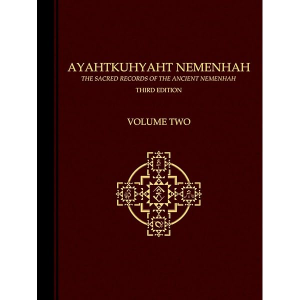 Moroni/Mohrhohnahyah appears to be Moroni’s final, holistic testament. It grounds his urgent warnings of destruction with the abstract doctrines of Priesthood found in The Book of Moroni and the Words of Moroni into practical communal laws and personal wisdom.
By detailing his experiences among the Nemenhah, a people who successfully preserved themselves by adopting peace and divine stewardship, Moroni offers a living model for the establishment of Zion. Here, he emphasizes that peace is attained not through military strength, but through unwavering faith, ecological integrity, and adherence to the Holy Order of God in both private and public life. Moroni warns that the future nations of the earth would also be driven “from the shedding of blood unto the shedding of blood, just as the Nayfihah (Nephites) and the Tsahrehtshah (Jaredites)” (Record of Mohrhohnahyah 4:22b).
Moroni also adds a new teaching, that women already possess the Holy Priesthood, having received the “saving grace and commission of the Mother” from their birth, and are ordained to offices (such as high priest or teacher) but not conferred the into these orders (Record of Mohrhohnahyah 12:82-84). This does fit in a way with Doctrines of the Saints 119, but seems to contain some of Moroni’s cultural bias that men and women are not equal in the site of God, stating that “men have not this grace from their birth and must receive it from the Peacemaker” (Record of Mohrhohnahyah 12:83b). This idea that men are somehow lesser then women in the eyes of God does stand out as an oddity. But I would agree that men and women have priesthood keys in us from birth (Doctrines of the Saints 119:17). Moroni also states here that the Mother is esteemed as the “most important person in the village,” and the Mother’s Council is the “governing council of the people” (Record of Mohrhohnahyah 8:35b). This again is close to Doctrines of the Saints 119, but shows some of Moroni’s cultural bias.
Moroni After Death
I, Moroni, did have many visitations from the beloved disciples and others, for they did go through the cities and gather unto themselves all who would not make a pact with the devil.” –Writings of Moroni 1:1 [1:1a]
Between these translations of the gold plates, Joseph Smith in the 1820’s and Maurício Berger in the 2010’s but closer to the second translation, we find Havah Pratt. The Writings of Moroni represent Moroni’s ministry as a resurrected or translated being, now speaking as a Shulemna (people of light/peace, from the Hebrew, Shalom), a Messenger of Light (Shulemnah 1:1a). These Shulemna were likely a people who also dwelled with the Nemenhah. This section is best described as the recordings of the voice of Moroni given to Havah Pratt following visions, placing it squarely in the context of modern spiritual revelation. Seeing the different translation methods used by Joseph Smith and Maurício Berger, Havah Pratt’s encounters are just as spiritual and can also only be explained as the power of God.
The Shulemna and the Holy Order of God
In the Writings of Moroni, Moroni relates that during the destruction of his own nation, he and a few others were ministered to by “beloved disciples and  others” (Shulemna), who changed his flesh so there was “light in me instead of darkness” (Writings of Moroni 1:1 [1:1a], 1:5 [1:2b]). Through faith, he and his followers entered a “higher order of things” and were preserved from death (Writings of Moroni 1:26 [1:7e]). As a translated being, Moroni emphasizes that this salvation was achieved by coming into Christ the Son, and then moving into Christ the Father (Writings of Moroni 1:75-78 [1:24-25]).
From the teachings in the Book of Moroni on how to run a group of believers in Christ and a handful of sermons, Moroni now teaches the “work of the Father is above the work of the Son” and cannot commence until the work of the Son is completed in an individual (Writings of Moroni 1:77 [1:25a]). And, that this Priesthood of the Father is the Holy Order of God, which governs all things in heaven and earth and is the source of the family of God (Writings of Moroni 4:9-12 [4:5]).
Cain as Zaiton
Here, Mormon introduces is to Zaiton as a sort of “god” of darkness, death, and defilement, which rose up in the world after Cain slew Abel by covenant with Satan. Zaiton is another name for the adversary Cain, Able’s twin brother. The term “Zaiton” is Arabic and Aramaic for “olive” or “olive tree.” Olives are traditionally symbols of peace, so why is Zainton, representing evil in the book, called an “alive tree?” Olive plants can be considered weeds in certain contexts. Wild or feral olives, particularly the African olive and Russian olive, can spread aggressively and become invasive, outcompeting native vegetation and disrupting ecosystems. They can spread rapidly through bird-dispersed seeds and create dense thickets, impacting biodiversity and potentially altering habitats. Invasive olive species can outcompete native plants for resources like sunlight, water, and nutrients, leading to a decline in native plant populations. The spread of invasive olives can disrupt natural ecosystems by altering vegetation composition, potentially affecting wildlife habitats and food sources.
For example, other plants die, and rabbits have nothing to eat. Fewer rabbits mean the fox has nothing to eat. This is how zaiton, invasive olive trees, destroy life. Controlling invasive olives can be challenging, often requiring a combination of manual removal and ongoing monitoring to prevent regrowth and further spread. Take this information and look at Zenos’ parable of the tame and wild olive trees in the garden. They must be constantly pruned, grafted, and monitored. It should also be noted that Zaiton is feminine, and seems to be a place not a person in other parts of the text. It may be that Zaiton is also the anti-Eden.To escape Zaiton’s dominion, one must overcome the “death that is in your flesh” (Writings of Moroni 15:21 [15:7b]). While these themes are not found in the gold plates, they would be more familiar to those who have studied the Nemenhah records.
Eden and the Gathering of Zion
 The goal of the Father’s work, according to the angel Moroni, is to gather the righteous and restore the original condition of joy and harmony, called Iton, a condition of joy, peace, love, light, truth, and exaltation which “belongeth to the gods who adhered in their daily walk to those laws,” the Edenic state (Writings of Moroni 14:14 [14:4a]). This is achieved by receiving Ra-shin (infusion of light/holiness) and adhering strictly to the laws of the Holy Order. Moroni specifically identifies the laws needed to reverse the corruption of Zaiton and build up the Holy Order: the laws of celestial plural marriage and the laws of consecration and the united order.
It should be noted here that this may refer to the sealing of people into the order of Zion as a community and not merely the Brighamite idea of plural marriage. Taking multiple spouses is not a work or requirement for salvation or exaltation. The Lord has said:
And also know this: a man may have one wife or one hundred wives; this does nothing to bring them closer unto me or unto my Father.” –Doctrines of the Saints 17e:10
In part two, we will look at how these separate books share common themes and tie Moroni’s teachings together, offering us more light and knowledge.
Note: This article excludes other writings of Moroni included at the end of the Book of Mormon (Mormon’s account of his own life in the Book of Mormon), throughout the Book of Ether, The Shulemna, and more for the sake of brevity. Readers are encouraged to study all of Moroni’s writings and share their thoughts in the comments below.


It would be great to include the other four Moroni writings. The Lamentation of Moroni received by Lucy Mack Smith, as found in the Second Book of Mor-Ahman, the Record of Murunhi published through the Ojibwe Sacred Records App by Chief Midegah, the books of Moroni in the Oracles of Mohonri, also found in the Second Book of Mor-Ahman and the writings of Moroni in the Sealed Portion published by Christopher Nemelka. Maybe for a part two article?