Thou shalt be washed, fully immersed in living water, be it by a running stream or with the mikveh; and this thou shall do to fulfill all righteousness; for except that thou born of the water, thou cannot enter into the Presence of Ha’Elohim; therefore ye shall shall wash with water that ye die not.”
–4 Moses 31:1-2
In Mormon Kabbalah, we seek to understand the truths of God and the universe. It is a path that values spiritual growth and personal experiences above rigid dogma. Here personal revelation and direct communication with God are the ultimate goals of the spiritual journey. Within this framework, the sacred rituals (Sacraments) of the Latter Day Saint movement are understood not merely as procedural obligations but as profound opportunities to unlock the mystical dimensions. Let’s dive into the sacred ordinances of baptism and temple washings. These hold a deeper, unifying purpose: to foster a direct and personal connection with the divine.
Ancient Foundation: The Torah of the Plates of Brass
To understand the covenant path, we must begin where Nephi began, with the critical necessity of obtaining the Plates of Brass. From a Kabbalistic perspective, these plates are more than a historical record. To us they are a physical kli, a vessel, designed to contain the divine light, Ha’Or En Sof, also known as the Light of Christ (Zenock 29:21-22). Nephi understood that without this vessel containing the light of the Torah, his people would inevitably fall into darkness. He reasoned, “…they could not keep the mitzvoth of YHVH according to the Torah of Moses, save they should have the Torah” (1 Nephi 1:117 [4:15]).
The plates contained the five books of Moses (1 Nephi 1:159 [5:11a]) and were of “great worth unto us, insomuch that we could preserve the commandments of the Lord unto our children” (1 Nephi 1:173 [5:21]). This scriptural foundation, rooted in the Torah of Moses, is the anchor for all subsequent ordinances. It establishes the ancient and enduring nature of divine covenants, providing the very architecture for the sacred rituals that give them life. With this foundation of written Torah established as the vessel for God’s covenant, the prophetic vision then turns to the first initiatory rite of that covenant: immersion in the waters of life.
The First Ritual on the Covenant Path
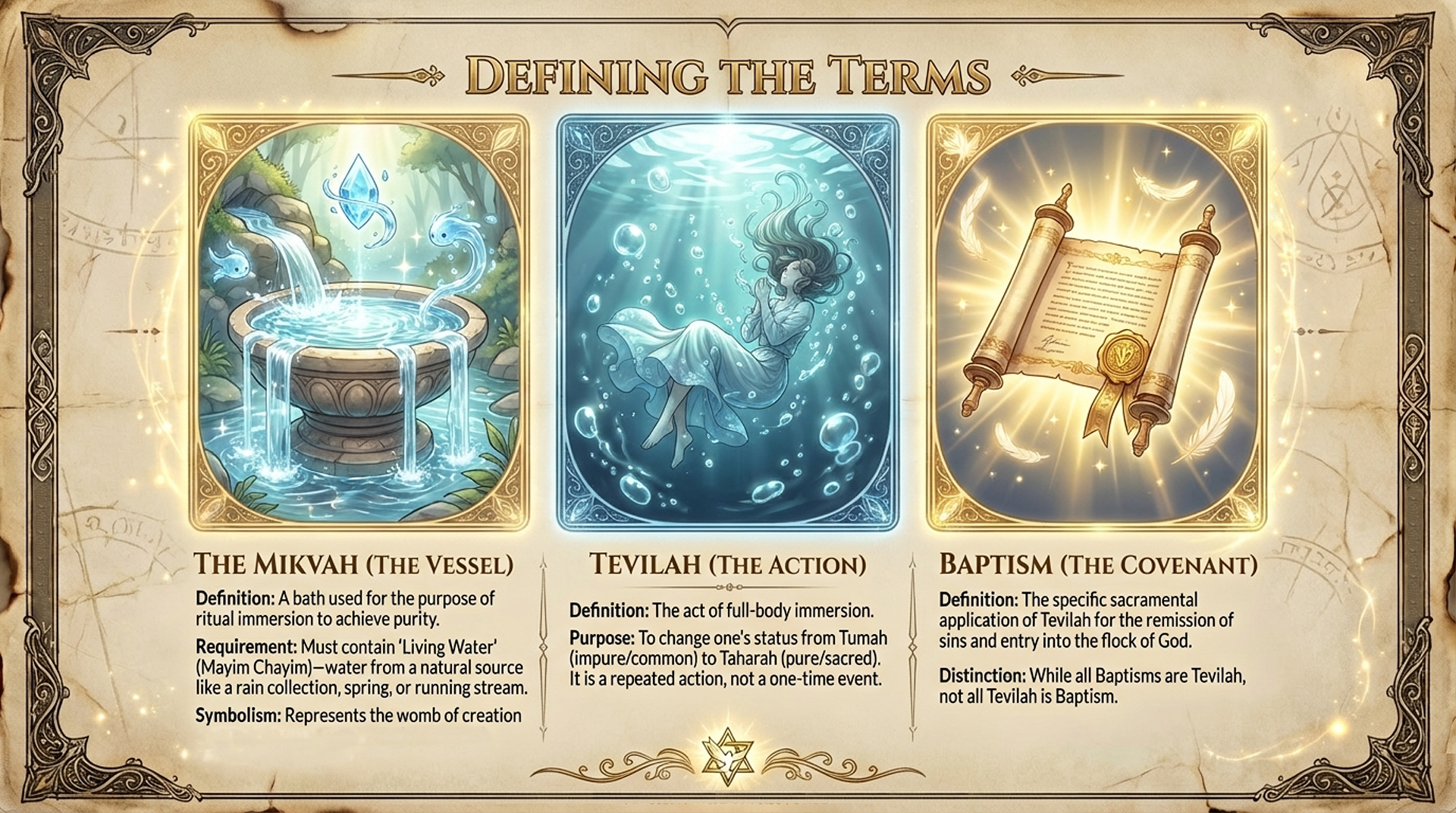
The ordinance of tevilah for baptism is the soul’s initial immersion into living water (mikvah). This is the current of divine energy that flows through creation, literally the Light of Christ, Ha’Or En Sof, symbolically water. This sacred act was prophesied by Lehi, who saw in his vision a “river of water” (1 Nephi 2:54a [8:13a]), which his son Nephi later understood to be the very love of God, a “fountain of living waters” (1 Nephi 3:68 [11:25a]). Lehi foretold of a prophet who would come “to prepare the way of the Lord” (1 Nephi 3:7 [10:7]), teaching that this man “should baptize in Bethabara, beyond Jordan” and that “he should baptize the Messiah with water” (1 Nephi 3:11a-b [10:9a-b]). The Living Water, Jesus, was washed clean in living water, the river. After this event, the prophet would “behold and bear record that he had baptized the Lamb of God, who should take away the sins of the world” (1 Nephi 3:12 [10:10]).
The tevilah of baptism, therefore, is more than a public declaration. It is a symbolic death of the self-serving individual (egoism) and a rebirth into Christ-like altruism. The act of immersion (mikvah) represents a conscious choice to submerge the ego and overcome negative qualities such as pride, selfishness, and egoism. It is the first essential step in entering a formal covenant relationship with God, aligning oneself with the divine flow and beginning the journey toward understanding the interdependence and interconnectedness of all things.
Temple Ordinances as a Framework for Deeper Awareness
Likewise, Temple ordinances represent a continuation and deepening of the covenant path initiated at baptism. Mystical practices associated with Kabbalah, like Latter Day Saint temple rituals, are often part of a broader framework of ethical and moral teachings. These ordinances are not secret traditions meant to exclude, but are sacred practices designed to facilitate greater spiritual awareness and connection with the divine. In fact, in Mormon Kabbalah, temple rituals are open to the public, in reverence. They provide the participant with a symbolic map of the spiritual journey from a pre-mortal existence to creation and, ultimately, to exaltation.
The progression seen is as one recieves each of the endowments is akin to the Kabbalistic Tree of Life, a diagram of the divine attributes through which the soul ascends back to its source. And they begin with a ritual washing, a tevilah. One is first washed with water, then anointed with oil. Through the framework of temple ritual, the participant is empowered to access a “deeper understanding of the universe and our place within it,” transforming abstract theological concepts into lived, spiritual realities. This would of course begin with a ritual washing.
Recognizing the Divine Spark
While the rituals of tevilah in baptism and temple ordinances are distinct, their ultimate spiritual purpose are one and the same: to help individuals cultivate a deeper connection with the divine. And, crucially, to recognize the divine spark within ourselves and others. This recognition is the very mechanism by which covenants prevent ordinances from becoming empty rituals, transforming them into conduits for divine connection.
From the vessel of the Plates containing the Light of the Torah, to the baptismal immersion in the Waters of Life, to the ascent through the symbolic mysteries of the Temple, each step is designed to strip away the ego and reveal the divine essence within. Mormon Kabbalah teaches that through these sacred acts, participants are aided in their effort to overcome negative qualities such as pride, selfishness, and egoism. By entering covenants to serve God and others, we begin to truly grasp the interdependence and interconnectedness of all things, and awaken to our shared divinity.
Your Personal Spiritual Journey
From the ancient Torah on the Plates of Brass to the living waters of baptism and the sacred ordinances of the temple, a unified mystical purpose emerges. These scripturally-grounded practices are a divine technology designed to methodically bring individuals closer to God, fostering personal revelation and a direct, unmediated connection with the divine light that animates the universe.
Ultimately, everyone’s spiritual journey is unique. What works for one person may not always work for another. The path of Mormon Kabbalah is not about prescribing a single formula but about providing principles and tools that empower you to see your own spiritual practice with new eyes. You are encouraged to engage in your own scripture study, prayer, and meditation to find what truly helps you feel most connected to God, unlocking the hidden architecture of your own covenant path. As you grow, enter the mikvah in tevilah to renew your baptism as often as you feel to do so.